Hair Mineral & Heavy Metal Test Kit
Easy at-home HAIR collection kit
Accurate lab analysis
Understanding Hair Mineral Analysis
What is hair mineral testing?
Hair mineral testing is a non-invasive laboratory procedure that analyses a small sample of your hair to measure the levels of essential minerals and toxic metals in your body. Using advanced techniques such as mass spectrometry, it provides a longer-term view of your body’s mineral status and metabolic activity — making it a valuable tool for identifying deficiencies, heavy metal exposure, and nutritional imbalances.
What type of scissors should I use?
Use clean, high-quality stainless steel scissors for cutting your sample. Rusty or unclean scissors risk contaminating the hair, which can compromise your results.
How do I cut my sample correctly?
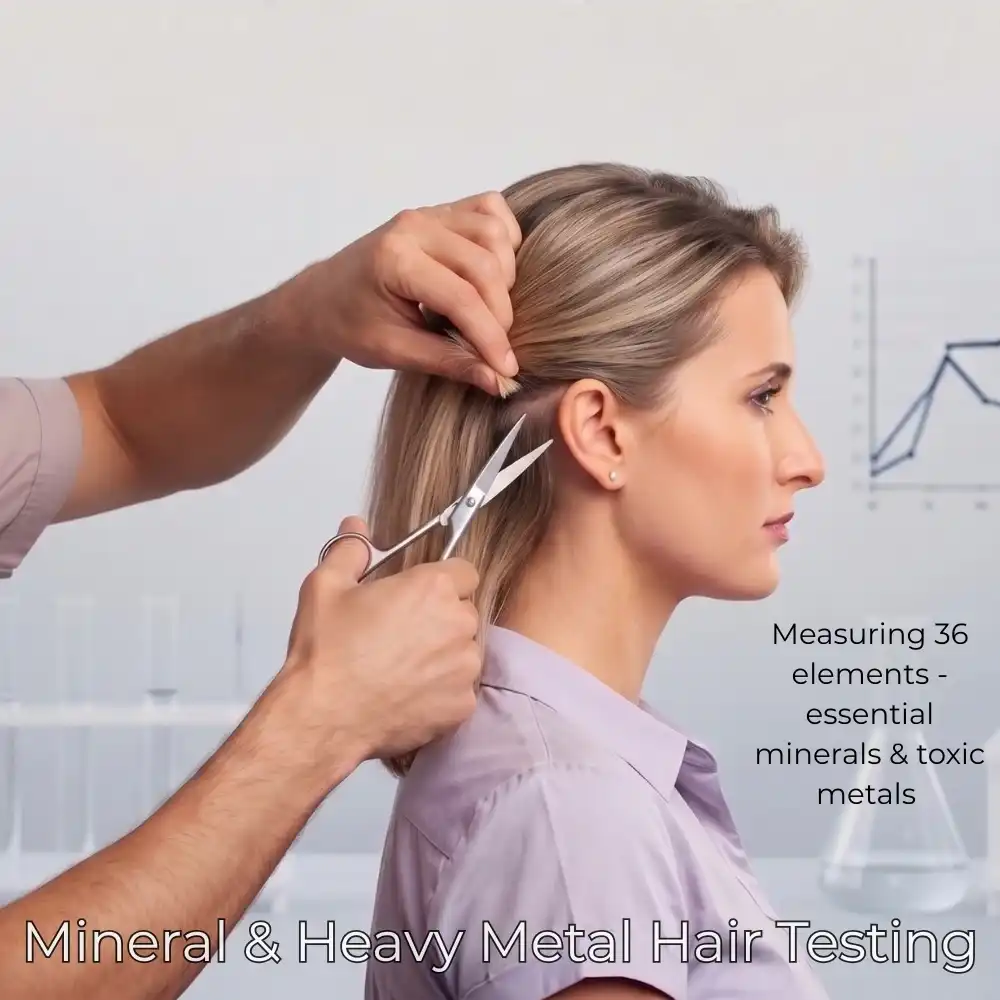
Carefully snip a small amount of hair from the back of your head, taking it as close to the scalp as possible — this area reflects your body’s most recent metabolic activity. Take thin strands from two or three different spots to ensure a well-rounded sample. Make sure your hair is fully dry before cutting, as damp hair can develop mould during transit to the lab.
How much hair do I need to provide?
Aim for strands no longer than 4 cm (roughly 1.5 inches), with a total weight of around 1 gram — about a heaped tablespoon of hair. Since hair typically grows around 1 cm per month, this length captures a recent window of metabolic history. To avoid delays, it’s better to provide a little more than too little.
Can I submit chemically treated hair?
No. Hair that has been dyed, bleached, or permed should not be submitted, as only natural untreated hair produces reliable results. If your hair is long, use only the portion closest to the scalp and set the rest aside.
Does it matter which shampoo I use beforehand?
Yes. In the lead-up to collecting your sample, avoid mineral-based shampoos, particularly anti-dandruff varieties, which can deposit minerals such as zinc onto the hair shaft and interfere with the analysis. Switching to a standard shampoo for at least three washes beforehand is recommended.
What if I don't have enough head hair?
If head hair is not available due to conditions such as alopecia, pubic hair may be used instead. Do not mix hair from different areas of the body — keep your sample consistent by using hair from one location only.
How should I package my sample?
Place your hair in a clean, unused paper envelope. Avoid recycled, foil-lined, or plastic envelopes, as these can cause contamination or trap moisture. Clearly write your full name, sex, age, and sample type (head or pubic) on the outside. Do not use staples to seal the envelope, as metal contact can affect the sample.
Should I avoid cutting my hair after submitting?
Yes. Hold off on cutting your hair until your results have been received, in case a follow-up sample is needed for further analysis.
How long will it take to receive my results?
Once your sample arrives at the clinic, allow 14–28 working days for processing. Within Australia, also factor in an estimated 7–10 days for postal transit. Providing a sufficient sample size from the outset will help avoid any unnecessary delays.
Step 1: Preparing Your Hair Sample
Review our step-by-step guide below on how to prepare your hair sample correctly
HOW TO PREPARE
Choosing the Right Scissors: Use clean, high-quality stainless steel scissors for cutting your sample. Rusty or unclean scissors risk contaminating the hair, which can compromise your results.
How to Cut Your Sample: Carefully snip a small amount of hair from the back of your head, taking it as close to the scalp as possible — this area reflects your body’s most recent metabolic activity. Take thin strands from two or three different spots to ensure a well-rounded sample. Make sure your hair is fully dry before cutting, as damp hair can develop mould during transit to the lab.
Getting the Sample Size Right: Aim for strands no longer than 4 cm (roughly 1.5 inches), with a total weight of around 1 gram — about a heaped tablespoon of hair. Since hair typically grows around 1 cm per month, this length captures a recent window of metabolic history. To avoid delays, it’s better to provide a little more than too little.
Use Only Natural, Untreated Hair: If your hair is long, use only the portion closest to the scalp and set the rest aside. Hair that has been chemically treated — dyed, bleached, or permed — should not be submitted, as only natural hair produces reliable results.
Shampoo Considerations: In the lead-up to collecting your sample, avoid mineral-based shampoos, particularly anti-dandruff varieties, which can deposit minerals such as zinc onto the hair shaft and interfere with the analysis. Switching to a standard shampoo for at least three washes beforehand is recommended.
Alternative Sample Sources: If head hair is not available due to conditions such as alopecia, pubic hair may be used instead. Do not mix hair from different areas of the body — keep your sample consistent by using hair from one location only.
Packaging Your Sample: Place your hair in a clean, unused paper envelope. Avoid recycled, foil-lined, or plastic envelopes, as these can cause contamination or trap moisture. Clearly write your full name, sex, age, and sample type (head or pubic) on the outside. Do not use staples to seal the envelope, as metal contact can affect the sample.
After Submitting: Hold off on cutting your hair until your results have been received, in case a follow-up sample is needed for further analysis.
Processing Timeframes: Once your sample arrives at the clinic, allow 14–28 working days for processing. Within Australia, also factor in an estimated 7–10 days for postal transit. Providing a sufficient sample size from the outset will help avoid any unnecessary delays.
Step 2: Mail Your Hair Sample To Us
Mail or drop off your hair sample at our centre
HOW TO SEND
Sending Your Sample: Before placing your sample in the post, make sure the hair collection envelope is fully sealed. Then place it inside a second outer envelope to protect the contents during opening and handling. A secure seal on the inner envelope is essential to prevent any risk of contamination.
Dropping It In Person: If you’re local, you’re welcome to bring your sample directly to our clinic. Please be aware that our reception team is unable to assist with hair collection in line with our health and safety guidelines. If you’d like hands-on support from one of our practitioners, this can be arranged through a consultation — though please note that a consultation fee will apply. For a simpler and more cost-effective option, we recommend asking someone at home to help you, as the collection process itself is quick and straightforward.
Where to Send Your Sample: Brunswick Health Clinic Hair Mineral Testing 1/68 Melville Road Brunswick West VIC 3055
Sending your sample to this address ensures it is received and processed promptly upon arrival.
Step 3: Health Questionnaire
Fill out and submit your personal health questionnaire online
HOW TO SEND
Completing Your Submission: When you’re ready to send your hair sample, please make sure to also complete the online health questionnaire available on our website.
This is a crucial step, as it complements your hair analysis for a thorough evaluation.
We do not provide collection kits, as the collection process only requires an envelope.
Simply adhere to the hair sample preparation and mailing guidelines outlined in Step 1 & 2.
Ensure that the completed questionnaire is submitted through our online portal, where it will be automatically received by our team.
This efficient approach eliminates the need for in-person visits or the waiting period for postal kits, streamlining the entire process.
Your sample will be analysed in the USA using state-of-the-art technology, guaranteeing the precision of your results.
This method not only expedites the analysis but also enhances the reliability of the findings, allowing us to deliver your results swiftly.
Step 4: Finalise Your Submission
When you have finished all of the above steps, you can go ahead and complete your payment
GO TO PAYMENT
Head to our online store to complete your payment. Before doing so, please ensure you have already filled out and submitted your health questionnaire and sent your hair sample to our clinic — having both of these steps done ahead of time will help ensure your results are processed as smoothly and promptly as possible.
Hair Mineral - FAQs
Browse our general FAQ for quick answers. Didn’t find what you were looking for? Give us a call or send us an email—we’re here to help!
Hair serves as a valuable medium for assessing the body’s mineral content, providing a long-term record retrospectively of metabolic activity.
Unlike blood samples, which can degrade or spoil, affecting the accuracy of results, hair samples are stable, easy to collect, and transport without risk of spoilage.
Hair analysis excels in evaluating the body’s mineral storage, offering insights into the levels of essential minerals such as zinc and copper accumulated over time.
It’s an optimal choice for understanding the body’s reserve of nutrients. However, for specific conditions like Pyrrole Disorder, which involves the interaction between copper and zinc, targeted urine tests are more suitable.
Please be aware that our services are focused on hair analysis, and we do not provide testing for urine or blood samples.
There’s absolutely no need for an in-person visit; you can complete the entire testing process comfortably from your home by following these straightforward steps:
Sample Collection: Gather a hair sample by adhering to our detailed guidance.
Questionnaire Completion: Fill out the online questionnaire to provide crucial information for the analysis.
Sample Submission: Mail your hair sample directly to our provided address.
Once we receive your hair sample and confirm your payment, our laboratory will begin the testing phase. Your comprehensive results will be promptly sent to you via email.
In-Person Consultation Option
For those who prefer or require assistance with hair sample collection, in-person consultations are available at our clinic. It’s important to note that opting for this service incurs additional charges due to the consultation time involved. While this option is available, we encourage you to consider the simplicity of self-collection. Not only is it more cost-effective, but it also allows you to allocate your resources towards the testing service itself. Please be reminded that our reception staff cannot assist with haircutting due to health and safety protocols.
Self-Collection Advantage
Collecting your hair sample independently is the most economical approach. Should you need help, an appointment with one of our practitioners can be arranged for sample collection, though this service does include a consultation fee. To avoid unnecessary costs, we recommend enlisting the help of someone at home for this simple procedure, thereby conserving your budget for the test itself.
Remember, each centimeter of hair length, measured from the scalp, represents one month of your body’s recent metabolic activity, providing a valuable snapshot of your mineral and heavy metal status.
The precision of our hair mineral and heavy metal testing is unparalleled, largely due to the exacting standards upheld by our affiliated laboratory in the USA. This facility is not only licensed by relevant authorities but also subject to independent audits, ensuring the utmost accuracy and dependability.
Renowned globally, the laboratory distinguishes itself with daily recalibration of its equipment, a regimen that significantly surpasses the typical weekly standard. This rigorous approach to accuracy, combined with significant investments in cutting-edge technology, reflects our unwavering commitment to delivering trustworthy results.
Despite the availability of more economical laboratory services closer to home, we place a premium on the fidelity and precision of our tests. Consequently, we choose not to compromise on quality to reduce costs. It’s imperative that the hair sample you provide is sufficient and prepared in accordance with our specific guidelines, to accurately reflect any mineral imbalances or signs of heavy metal exposure in the results.
Our chosen laboratory in the United States is not only fully accredited and certified as a clinical laboratory but is also celebrated for its exemplary standards. Trace Elements Inc., holding License Number 45-D0481787, is esteemed for its methodological excellence, particularly its policy against the chemical washing of hair samples prior to analysis, a practice that can alter test outcomes and is employed by some other laboratories.
Essential Nutritional Minerals.
| Calcium (Ca) | Magnesium (Mg) | Sodium (Na) | Potassium (K) |
| Copper (Cu) | Zinc (Zn) | Phosphorus (P) | Iron (Fe) |
| Manganese (Mn) | Chromium (Cr) | Selenium (Se) | Sulphur (S) |
| Cobalt (Co) | Molybdenum (Mo) | Boron (B) |
Additional Trace Minerals
| Germanium (Ge) | Barium (Ba) | Bismuth (Bi) | Rubidium (Rb) |
| Lithium (Li) | Nickel (Ni) | Platinum (Pt) | Thallium (Tl) |
| Tin (Sn) | Vanadium (V) | Strontium (Sr) | |
| Titanium (Ti) | Tungsten (W) | Zirconium (Zr) |
Toxic Heavy Metals
| Mercury (Hg) | Lead (Pb) | Arsenic (As) | Beryllium (Be) |
| Aluminium (Al) | Cadmium (Cd) | Uranium (U) | Antimony (Sb) |
The scope of our mineral and heavy metal hair analysis is specifically confined to the elements enumerated previously. The range of elements tested cannot be expanded beyond those specified on this page.
Essential Minerals: These minerals are pivotal for a myriad of physiological functions, including muscle function, reproductive health, hormone synthesis, maintaining bone strength, and facilitating the effective action of vitamins, thereby underpinning overall growth and development.
Toxic Minerals and Heavy Metals: The accumulation of these elements over time can lead to significant health risks. Notably, hair can contain concentrations of toxic elements that are 200 to 300 times higher than those found in blood or urine, making it an ideal medium for detecting recent exposures to heavy metals. It’s important to note that individuals with elevated levels of these toxic minerals may not initially show the clinical symptoms associated with their toxicity, allowing these conditions to remain undiagnosed for extended periods.
Mineral Ratios: The analysis of ratios between essential minerals can often reveal underlying imbalances that may contribute to health issues. For instance, in managing conditions like osteoporosis, the efficacy of calcium supplementation can be contingent upon the correct Calcium: Magnesium ratio, emphasizing the importance of a balanced mineral profile for optimal health.
Determining Levels of Heavy Metals and Minerals: Our analytical process visually represents the levels of various elements through a bar graph, delineating the low, acceptable, and high ranges clearly. These measurements are expressed in parts per million (ppm) and derived using Inductively Coupled Plasma (ICP) mass spectrometry, ensuring precise quantification.
A comprehensive hair analysis report not only identifies high concentrations of harmful metals in your system but also provides guidance on safe detoxification methods to address symptoms of serious metal poisoning.
Hair Mineral Analysis offers a detailed view of mineral and heavy metal levels but has certain limitations:
Alternative Samples: In the absence of hair, clean fingernail clippings can be used. However, this method primarily detects toxic minerals with less reliability for nutrient mineral analysis.
Synthetic Hair: The test is valid only for genuine hair samples, as synthetic hair does not reflect the body’s metabolic activities.
Influence of Treatments: The presence of chemical treatments, dyes, or medicated shampoos can affect the integrity of the sample. It’s recommended to use natural, untreated hair for accurate results.
External Contaminants: Recent use of lice treatment or exposure to other contaminants necessitates a waiting period and thorough washing before sample collection to avoid skewed results.
The primary aim of hair analysis is to assess individual health rather than hair condition.
When head hair is not available, underarm or pubic hair may be utilised as substitute samples for conducting mineral and heavy metal tests. It’s important to note, however, that the growth rates of body hair, such as underarm hair, differ significantly from those of head hair. This variance can obscure the precise timing of toxin exposure or nutrient deficiencies.
Head hair, growing at a more uniform rate of about 1 cm per month, provides a more accurate record of metabolic activities over time.
In cases where head hair is entirely absent, underarm or pubic hair, collected as close to the skin as possible, serves as a viable alternative, particularly for detecting toxic mineral levels. Nonetheless, the capability of these samples to assess nutrient mineral levels might not be as reliable.
When submitting a sample, please provide a substantial amount—approximately 2 heaped tablespoons—ensuring not to mix hair types within a single sample to preserve the accuracy of the analysis.
Whenever possible, it is advisable to wait for the regrowth of head hair to achieve the most precise results from your mineral and heavy metal testing.
Timeline and Delivery of Results: The analysis process commences upon receipt of your hair sample, completed health questionnaire, and payment, typically requiring 3-4 weeks to complete. Delays may arise primarily due to the transit time of your sample to our US-based laboratory. To ensure swift access to your results, we deliver them via email. If email is not an option for you, consider having a friend receive the results on your behalf. Standard delivery is digital, but we can accommodate requests for printed copies at an additional charge.
Understanding Your Results: The mineral analysis report is intricate, packed with valuable data that necessitates expert interpretation. We urge you to consult a Qualified Health Professional who is versed in such analyses for an accurate understanding. If you are currently working with a health professional, we recommend sharing your results with them. Alternatively, Carmen Farrugia, our resident Naturopath with a specialisation in mineral analysis, is available for in-depth consultations, which are subject to a fee.
Report Insights: Designed for clarity, the report features a colour-coded graph that vividly displays your mineral and heavy metal levels and their interrelations, complemented by an in-depth written analysis. Given the complexity of this information, seeking a professional’s guidance is advisable to fully leverage the report’s insights.
Consultation Options:
Option A – Consult Your Health Professional: Pre-sharing your results with your health professional can be incredibly useful, giving them ample time to prepare for a productive consultation.
Option B – Consultation with Naturopath Carmen Farrugia: For those without a personal health professional or seeking additional insights, our clinic provides telehealth and in-person consultations with Carmen Farrugia. Contact us at 03 9380 8099 to schedule a session focused on interpreting your hair analysis report and discussing its health implications.
To effectively monitor your mineral balance and assess potential exposure to toxic metals, undergoing hair analysis annually is recommended. This frequency ensures a comprehensive overview of your body’s mineral status and any toxic accumulations over time.
Individuals exposed to higher levels of environmental or occupational toxins might consider more frequent testing to vigilantly track any changes.
Retesting Intervals
The appropriate timing for retesting is influenced by your specific health concerns and the reasons behind the initial test. Whether you’re investigating potential mineral deficiencies or concerned about exposure to toxic heavy metals due to your living or working environment, the growth rate of head hair (approximately 1 cm per month) can serve as a guide for planning your retests.
Typically, a 3-month interval between tests is beneficial, as it provides a snapshot of the last 12 weeks, offering a sufficient timeframe to detect significant changes in mineral levels or toxic metal accumulation in most scenarios.
The inclusion of mineral and heavy metal testing in private health insurance plans is not uniform and typically falls outside the scope of standard policy coverage. Coverage details are highly individualised, hinging on the specific terms and categories defined by each insurance provider.
To ascertain if your policy encompasses this type of testing, reaching out to your insurance provider for direct confirmation is advisable.
Please be aware that Medicare does not extend coverage to mineral and heavy metal testing, as it is not featured in the Australian Medicare Benefits Schedule.
To view the cost of hair mineral testing go to our online store
Can I Test My Pet's hair?
Yes, for dogs & horses only.
Please note that our clinic, being a health centre for humans, strictly prohibits pets on the premises due to health regulations. Therefore, hair sample collection for your pet must be done at home and sent to us following the provided instructions.
We emphasise that our facility is not equipped to offer veterinary advice or interpret test results. For a detailed analysis and professional recommendations, we strongly advise consulting with a veterinarian.
To begin, follow the same hair collection procedure as for humans, with the key difference being the hair collection site suited to your pet. After gathering the hair sample, clearly label the envelope with your pet’s name, sex, age, and breed.
For Dogs: Collect hair from the back of the neck, above the shoulders, ensuring each strand is no more than 4cm in length. If the hair is longer, keep only the portion closest to the root, discarding the excess. Aim to collect around half a gram (or 1 tablespoon) of hair.
For Horses: Cut hair from the lower part of the mane at the back of the neck, adhering to the 4cm length maximum for each piece. Keep only the segments closest to the skin, targeting half a gram (or 1 tablespoon) of hair for your sample.
Please complete the contact form below, providing us with essential information about you and your pet. This will help us accurately match the arriving hair sample to your submission.
For Pet Mineral & Heavy Metal Hair Testing (Plus Comprehensive Report), we test for the following:
Essential Nutritional Minerals
| Calcium (Ca) | Chromium (Cr) | Cobalt (Co) | Copper (Cu) |
| Iron (Fe) | Magnesium (Mg) | Manganese (Mn) | Molybdenum (Mo) |
| Phosphorus (P) | Potassium (K) | Selenium (Se) | Sodium (Na) |
| Sulphur (S) | Zinc (Zn) | Boron (B) ~ Optional as Additional Fees Apply |
Additional Trace Minerals
| Barium (Ba) | Germanium (Ge) | Lithium (Li) | Nickel (Ni) |
| Platinum (Pt) | Strontium (Sr) | Tin (Sn) | Tungsten(W) |
| Vanadium (V) | Zirconium (Zr) |
Toxic Heavy Metals
| Aluminium (Al) | Arsenic (As) | Beryllium (Be) | Cadmium (Cd) |
| Lead (Pb) | Mercury (Hg) | Uranium (U) |
The analysis of your pet’s hair sample begins as soon as we receive it along with your payment, with the process typically taking 3-4 weeks. The primary factor in any delay is usually the shipping time to our laboratory in the US.
Results are sent directly via email for quick access; if you’re unable to receive emails, you might arrange for a friend to accept them on your behalf. While digital delivery is our standard method, printed reports are available for an extra fee upon request.
Please note, as we are not veterinary professionals, our facility cannot provide veterinary advice or interpretations of the test results. For an in-depth analysis and expert guidance, we recommend consulting a veterinarian.
To view the cost of hair mineral testing for pets go to our online store
Testing Your Pet's hair
Step 1: Preparing Your Pet's Hair Sample
Read instructions on how to best prepare your pet’s hair sample
HOW TO PREPARE
Preparation:
Ensure the hair is thoroughly washed, untreated, completely rinsed, and dried.
Ensure your pet’s hair is completely dry; wet or damp hair may develop mould during transit to the laboratory.
Canine Hair Sample:
Cut several sections from above and below the collar, avoiding areas with topical treatments.
Horse Hair Sample:
Cut multiple sections from the lower part of the mane.
Cutting Procedure:
Use high-grade stainless steel scissors to prevent contamination.
Cut the hair as close to the skin as possible.
The hair length should not exceed 5-6 cm. Retain the proximal (root) portion and discard the rest, as this part reflects the most recent metabolic activity.
Sample Amount:
Collect approximately half a gram of hair, or about one tablespoon.
Sample Packaging: Place the hair sample in a clean, new paper envelope.
Avoid using recycled, aluminium, or plastic envelopes as they can lead to contamination or moisture retention, respectively, affecting the analysis.
Label the envelope clearly with your full name and your pet’s name.
Refrain from using staples to secure the envelope to prevent metal contamination.
Turnaround Time: Anticipate a processing period of 14-28 working days from when the clinic receives your sample.
Account for potential postal delays, estimated at 7-10 days within Australia.
Insufficient sample size may cause delays, so err on the side of providing slightly more.
Step 2: Submitting Your Pet's Hair Sample
Mail or drop off your pet’s hair sample at our centre
OUR MAILING ADDRESS
Dispatching Your Sample: Prior to dispatch, double-check that the hair collection envelope is completely sealed.
Subsequently, encase this within a secondary mailing envelope to prevent any loss of hair during the opening process.
It is crucial to thoroughly seal the primary envelope to avert contamination.
In-Person Submissions and Support: For those residing locally, you are welcome to submit your pet’s sample directly to our clinic. Please note as we are a health clinic, animals are prohibited from entering the clinic due to health regulations.
It is important to note, however, that our front desk staff are unable to assist with hair sample collection, adhering to health and safety protocols.
Please address your sample to Brunswick Health Clinic Hair Mineral Testing, 68 Melville Road, Brunswick, VIC 3055, ensuring direct and prompt processing upon receipt.
Step 3: Pet's Health Questionnaire
Complete & submit your online pet health questionnaire
CLICK TO COMPLETE
Completing Your Submission: When you’re ready to send your pet’s hair sample, please make sure to also complete the online health questionnaire below.
This is a crucial step, as it complements your pet’s hair analysis for a thorough evaluation.
We do not provide collection kits, as the collection process only requires an envelope.
Simply adhere to the hair sample preparation and mailing guidelines outlined in Step 1 & 2.
Ensure that the completed questionnaire is submitted through our online portal, where it will be automatically received by our team.
This efficient approach eliminates the need for in-person visits or the waiting period for postal kits, streamlining the entire process.
Your pet’s hair sample will be analysed in the USA using state-of-the-art technology, guaranteeing the precision of your results.
This method not only expedites the analysis but also enhances the reliability of the findings, allowing us to deliver your results swiftly.

Step 4: Finalise Your Pet's Submission
Once all steps are completed, proceed to payment!
GO TO PAYMENT
Final Steps for Submission: Proceed to our online store to finalise payment.
Make sure you have submitted your pet’s Health Questionnaire and mailed the hair sample to our clinic to facilitate a smooth and timely process.